***
My Sister’s Early Years
Amanda was born in late 1966 while Dad was serving in Vietnam. Mum stayed with Grandma Jean and Grandad Walt during his absence, raising a newborn daughter while her husband was thousands of kilometres away.
It’s hard to imagine what life was like for them back then. There were no video calls or instant messages and no easy way for a father overseas to watch his daughter grow. A long-distance telephone call from a suburban lounge room to a war zone simply wasn’t on the table. News and photographs travelled the old-fashioned way and the wait between sending something and getting a reply could feel like an eternity.
Meanwhile, the war itself turned up on the evening news, flickering across the black-and-white television between the ads. With Dad serving in Vietnam, I imagine those reports brought the war a little closer to home, making it impossible for Mum to watch without thinking about the man she loved and wondering how he was doing.
One of the photographs I have from that period gives a glimpse of the family Dad had left behind. It’s a professional portrait of Mum, Grandma Jean and Amanda, taken in early 1967 while Dad was serving in Vietnam and sent to him overseas. It represented a picture of the family waiting for him at home.
In those days, having a studio portrait taken meant dressing in your best clothes and making a special trip to a photographer who knew exactly how to position everyone in the frame. Mum, with her short dark hair, a cream collared top and a thin gold chain, holds baby Amanda in a white gown. Grandma Jean sits beside them in a pale blue cardigan and patterned skirt with her grey hair neat. She looks straight at the camera through her glasses with one hand supporting the baby. Behind them hangs an olive-green and gold curtain, the sort of backdrop that turns an ordinary family moment into something formal enough to send across the world. The image colours have the soft, hand-tinted look of studio portraits at the time.
There are fewer photographs of Grandma Jean than I’d like, which makes this one especially precious to me. She passed away in 1976, the year I turned seven and what survives of her is a handful of pictures and a lot of questions. This one captures three generations of my family at a time before I came along, when Amanda was still a baby and Dad was away doing his duty.
Dad didn’t meet Amanda until he came home in 1967. Although he knew she was on the way before he left for Vietnam, by the time he returned she was no longer a newborn but a little girl who had spent the first months of her life without him. He had left his pregnant wife behind and returned to meet the daughter he’d only known about from a distance.
Another family photograph captures a playful moment when everyone is smiling for the camera in the hillside garden. Our timber house stands raised up behind a wire fence with steps leading to the door. A garden fork leans on a post and a jacket hangs up out of the way, as if somebody has just stepped inside for a cup of tea. Grandma Jean is wearing a short-sleeved dress and sandals while Mum is in a navy-and-white striped top with dark trousers. They are both swinging Amanda between them by the hands. Amanda is a toddler now, her feet off the ground and the grown-ups are plainly enjoying the game as much as she is.
It says more about that household than any caption could. Three generations in one garden, a small girl with plenty of people ready to lift her off her feet and the ordinary clutter of a family getting on with life.
Before I Arrived
My story began late June, 1969 in Upper Ferntree Gully, Melbourne and I remember absolutely none of it. It was a Saturday in the middle of a Melbourne winter which is the kind of timing nobody thinks to run past the baby. My earliest childhood memories were still years away, waiting for me to be old enough to wander off and start collecting adventures of my own. But every story has to begin somewhere and mine begins with a young family and a house in Melbourne, situated at the foot of the Dandenong Ranges with a future that was already packing its bags to take us somewhere else.
This was the family home, where Mum and Dad were living with my older sister Amanda and my grandparents, Jean and Walt. Later, into that full house I would arrive, joining a family that had already known separation, military service and the uncertainty of having a husband and father in the Australian Army. Six of us under one roof, counting the new baby, who contributed very little to the household beyond noise.
Upper Ferntree Gully sits about thirty-two kilometres east of the city, at the point where suburban Melbourne runs out of suburbia and the Dandenong Ranges take over. In those days the red electric train from the city ran out to the foothills and a little further up the line Puffing Billy, the old narrow-gauge steam train, had been brought back to life by volunteers only seven years before I was born. It was puffing its way through the tree ferns and the mountain ash again. Melbournians had been escaping to those hills for generations and plenty still did. A boy could hardly have asked for a more scenic place to be born, even if he was in no position to notice.
Under One Roof
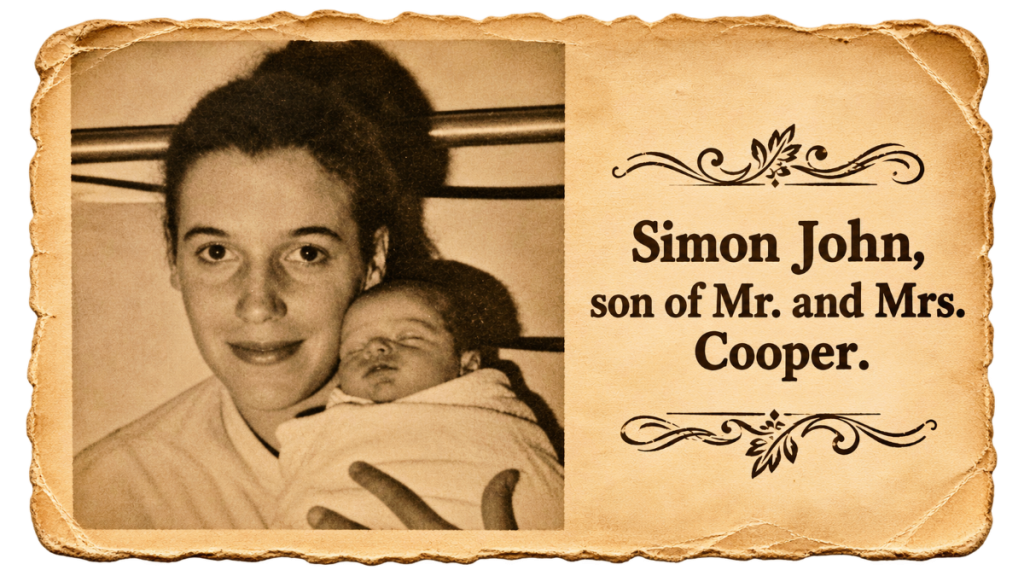
And just like that, approximately two years later, the Cooper family had another little mouth to feed – me! A picture was taken at Ferntree Gully Hospital a day or two after I was born and the local paper ran it in their next edition. In those days a mother stayed in hospital for a week or more after a birth and fathers weren’t allowed in the delivery room. They waited, paced and visited until the ward and nurses allowed them.
In the photo mum holds me close against her cheek and shoulder, her face turned towards the camera with her dark eyes wide and the beginnings of a smile. I sleep peacefully in her arms, nestled against her as though there is nowhere else in the world I need to be. Looking at this now, I feel a deep sense of pride. This is the woman who gave birth to me and the person who held me at the very beginning of my life. Our bond had just begun, even if neither of us could have known what lay ahead.
The newspaper caption identifies me as Simon John, son of Mr and Mrs Ian Cooper of Upper Ferntree Gully. Mum, who had done all the hard work, doesn’t even get her own name. That was simply how the papers did it back then.
And there I was, apparently newsworthy enough to earn a place in the local paper. Stop the presses!
In those days, young couples often started out under their parent’s roof. This made total sense with Dad’s Army pay and his growing family needs. I have to piece that part of my life together from photographs and stories that have been passed down to me. They are only small, unique fragments but when put together they help me imagine the world that was waiting for me at the beginning.
This clipping is a small window into the beginning of my life. It reminds me that before the adventures, the schoolyard dramas, the friendships and the places that would eventually fill my memories, there was simply a baby being held by his mother.
I had no idea what lay ahead. Then again, at that age, I probably had very few expectations beyond the next feed.
Around that time, the wider world had its own plans. Exactly a month to the day after I was born, black-and-white pictures of Neil Armstrong stepping onto the Moon flickered across television sets all over Australia. The telescope at Parkes and the tracking station at Honeysuckle Creek helped bring those pictures to the world, with Australians apparently seeing them a split second ahead of everyone else.
Nobody has ever told me where everyone was at that time and I certainly wasn’t taking notes. But I’m pleased to say, I arrived a month before humans reached the Moon which I like to think makes me an early adopter.
Grandad Walt
One of the family stories from those early years involves Dad and Grandad Walt going out to shoot pigs and rabbits for Sunday roast dinners. In our house, the roast didn’t always start at the butchers and rabbits were cheap and plentiful. Australians had long called them ‘underground mutton’ so a rabbit or two in the roasting dish was nothing to be embarrassed about.
When I think of a family Sunday roast, I picture the end of a familiar routine. Someone preparing vegetables, the smell of food coming from the kitchen and everyone eventually gathering around the table. In a Melbourne winter, with six mouths to feed, I picture the kitchen windows fogged up and the oven earning its keep. In my family’s case, at least some of the meat began with Dad and Grandad setting out together with their guns.
I have no memories of tagging along, watching them return or waiting impatiently for dinner. But I like the picture this leaves behind, with Dad and Grandad heading out together to bring home something for the family meal. It gives me a small sense of the world I was born into. These are the details that make family history feel real, not just the major events recorded on a timeline but the ordinary habits and routines that filled the spaces between them.
Grandad was a veteran of the Second World War, part of a generation whose lives had been shaped by a very different time. He was born in 1912 so he would have been twenty-seven when the war began and in his mid-fifties when I came along. I know little about his wartime experiences but knowing he served, adds another layer to my family history. Here was my grandfather, a man who had lived through a world war, sharing everyday life with Dad and helping provide for the family in his own way.
Dad still wears his own medals alongside Grandad Walt’s on ANZAC Day. By custom, a veteran wears his own medals on the left breast and a relative’s on the right so Dad marches with both generations on his chest. I would have loved to sit down with Grandad as an adult to hear about his experiences during the Second World War. What did he do? Where did he go? What did he see? What was he like as a young man, before he became the grandfather I knew? And what stories might Dad have been able to tell me about his own father that I’ve since forgotten?
Dad would have told me stories when I was younger. I’m sure of that but children don’t always realise they’re listening to pieces of history. Sometimes you hear a story when you are young, take it in for a moment and then rush off to do something far more important, like play with your toys. You assume the people telling you these things will always be around and that you’ll have plenty of time to ask them about it later. Perhaps that’s one of the ironies of growing older. You spend your childhood wanting to know what’s coming next and then one day you find yourself wishing you could go back and ask a few more questions about what came before.
Leaving Melbourne
Of course, Dad’s Army career meant our lives would never stay settled for long. Military families had to be ready for new orders, new homes and new surroundings at any moment. Then, just when you think you’d got to know one place, the next posting could send you somewhere completely different. This time the orders were for a posting to Singapore.
For the adults, that meant preparing for major change like leaving Melbourne, travelling overseas and starting another stage of Army life. For Amanda, still a young child, it meant leaving the only world she had known. For me, it meant that my first year of life was about to take me somewhere I would never be able to remember visiting. Fortunately for Grandma Jean and Grandad Walt, it probably meant a house that was suddenly going to go very quiet.
There’s something special about the timing of that trip. On the very day I turned one, we flew out of Australia for Singapore. International flying was still an occasion in 1970, the kind of trip people dressed up for. Birthdays, overseas postings and the idea of leaving one home for another meant nothing to me. Whether a candle ever made it onto a cake is anyone’s guess. I certainly wasn’t sitting there contemplating the implications of international travel. At age one, the world was whatever happened to be in front of you.
Dad, no doubt, had rather more on his mind. He was petrified of heights and a family story goes that when he finished his duty in Vietnam and was evacuated on a jet fighter plane, he fainted before it had even left the tarmac. God knows how he got himself onto a plane to Singapore.
But for Mum and Dad, it was another significant step in their life together. They had gone from a young couple starting a family to parents of two children and now they were taking that family overseas. Whatever happened during the preparations, the packing, the journey and the arrival in Singapore must be pieced together from the records and stories that remain.
***